FT-WBC: Learning Fault-Tolerant Whole-Body Control for Legged Loco-Manipulation

Yudong Zhong1, Pengfei Mai1, Sikai Guo1, Jiahang Cao2, Zhihai Bi1,
Qiuyue Liu1, Ziyan Feng1, Jinni Zhou1, Jun Ma1
1The Hong Kong University of Science and Technology (Guangzhou)
2The University of Hong Kong

Baseline Policy Fails Without Fault Tolerance

Locomotion baseline under FL hip failure.

Locomotion baseline under RL calf failure.

Whole-body baseline under FR calf failure.

Whole-body baseline under RL thigh failure.

Nominal loco-manipulation policy quickly loses balance after actuator failures.

Abstract

Legged manipulators combine the mobility of quadruped platforms with the manipulation capability of robotic arms. However, arm-induced center-of-mass shifts and dynamic disturbances make the whole system more vulnerable to actuator failures, which can cause falls, object drops, and task failures.

We propose FT-WBC, a fault-tolerant loco-manipulation framework for robust whole-body control under lower-limb actuator failures. FT-WBC adopts a decoupled upper- and lower-body policy architecture and introduces two key modules: a Fault Estimator (FE), which predicts faulty joints from proprioceptive histories, and a Posture Adaptation Module (PAM), which converts manipulation-driven base posture plans into safe and executable posture commands.

Through fault-aware posture adaptation, FT-WBC synthesizes compensatory gaits, preserves as much arm workspace as possible, and maintains whole-body stability. Simulation and real-world experiments on a Unitree Go2 with an Airbot Play arm show improved survival rate and reachable workspace under weakening and locked failures, with zero-shot transfer to the real robot.

Overview Video

Framework Overview

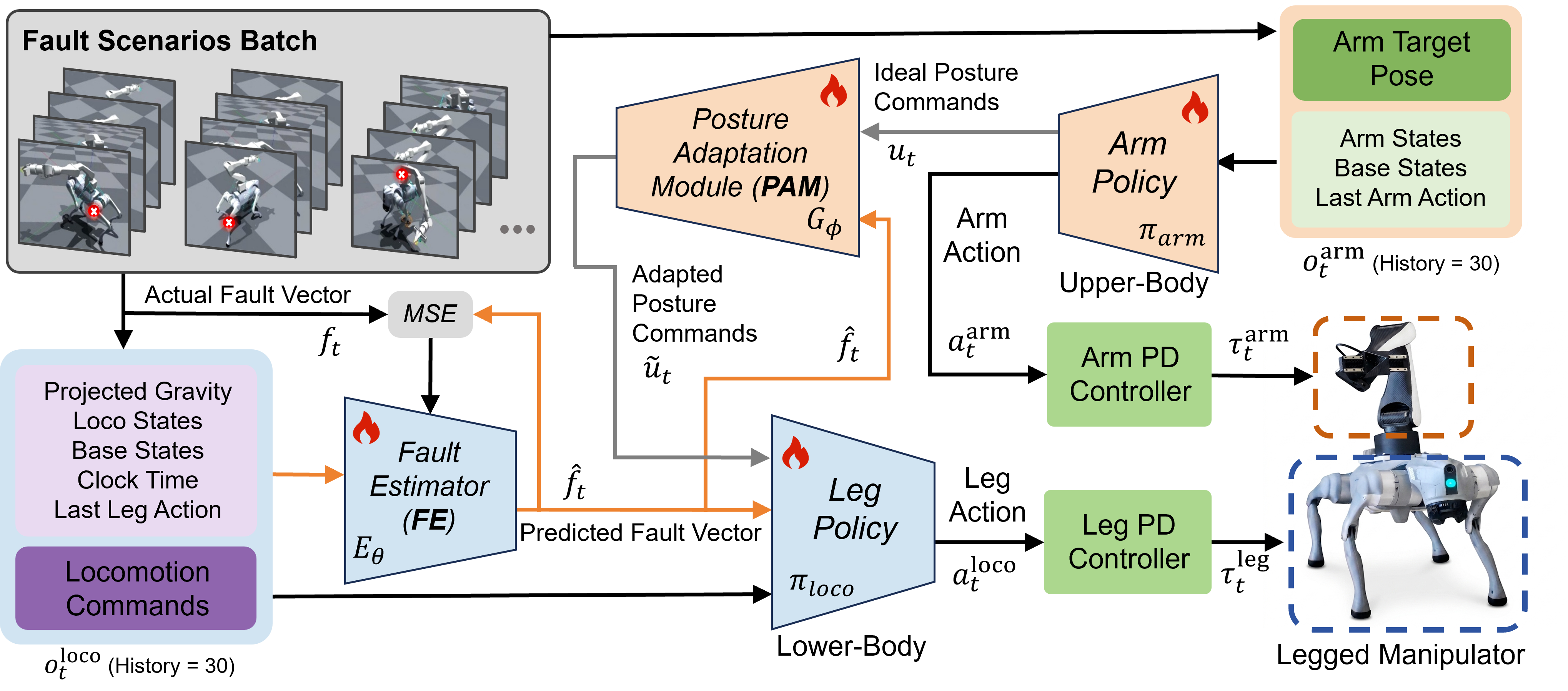
FT-WBC framework overview.

FT-WBC adopts a decoupled architecture consisting of a lower-body leg policy and an upper-body arm policy. The leg policy generates quadruped joint actions from target motion commands and the predicted fault vector, while the arm policy tracks the target end-effector pose and outputs both arm joint actions and a desired base posture plan. The FE predicts joint fault conditions, and the PAM remaps the desired base posture plan into a safe posture command, enabling fault-aware whole-body control under actuator failures.

Real-World Demonstrations

Weakening Faults

Locomotion

FL Hip

FL Calf

FR Thigh

RL Thigh

RR Hip

RR Calf

WBC

FL Hip

FL Calf

FR Thigh

RL Thigh

RR Hip

RR Calf

Pick and Place

FL Hip (side view)

FL Thigh (side view)

RL Calf (side view)

FL Hip (front view)

FL Thigh (front view)

RL Calf (front view)

Locked Faults

Locomotion

FL Hip

FR Thigh

FL Calf

RR Hip

RL THIGH

RR Calf

WBC

FL Hip

FL Calf

FR Thigh

RL Thigh

RR Hip

RR Calf

Pick and Place

RL Hip (side view)

RL Thigh (side view)

FL Calf (side view)

RL Hip (front view)

RL Thigh (front view)

FL Calf (front view)

BibTeX

@article{zhong2026ftwbc,
  title   = {FT-WBC: Learning Fault-Tolerant Whole-Body Control for Legged Loco-Manipulation},
  author  = {Yudong Zhong and Pengfei Mai and Sikai Guo and Jiahang Cao and Zhihai Bi and Qiuyue Liu and Ziyan Feng and Jinni Zhou and Jun Ma},
  journal = {arXiv preprint arXiv:2606.24466},
  year    = {2026},
}